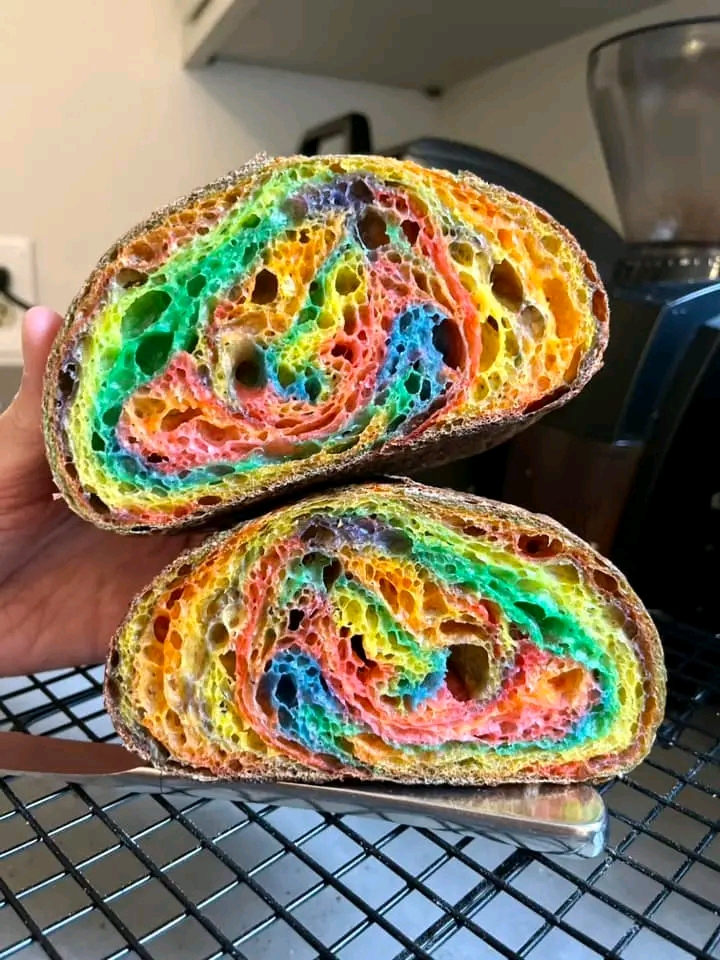
A step-by-step guide to baking a vibrant, colorful sourdough that’s as delicious as it is beautiful
If you’ve ever seen a loaf of rainbow sourdough and thought “that’s impossible to make at home” — think again. This bread combines the classic art of sourdough fermentation with vivid food coloring to create a crumb that looks like a tie-dye masterpiece. Whether you’re baking for a party, a content piece, or just to blow your family’s minds, this recipe will guide you from starter to sliced loaf.
The secret? No special ingredients — just your usual sourdough dough, gel food coloring, and a bit of patience during the lamination and folding stages. Let’s get into it.
Ingredients
For the dough:
450g (3 ¾ cups) bread flour
325g (1 ⅓ cups) lukewarm water
90g (⅓ cup) active sourdough starter
9g (1 ½ tsp) fine sea salt
For the colors:
Gel food coloring in at least 6 colors: red, orange, yellow, green, blue, purple
Small bowls or cups (one per color)
Plastic wrap or gloves to avoid staining your hands
Tools You’ll Need
Dutch oven (essential for a great crust)
Banneton proofing basket or a bowl lined with a floured towel
Digital kitchen scale
Bench scraper
Lame or razor blade for scoring
Step-by-Step Instructions
Step 1 — Make the Autolyse (Day 1 Morning)
Mix the flour and water (hold back 25g of water) in a large bowl until no dry flour remains. Cover and let rest for 30-60 minutes. This step develops gluten naturally before adding the starter and salt.
Step 2 — Add Starter and Salt
Add the sourdough starter and salt to your autolysed dough. Use the remaining 25g of water to help incorporate. Mix thoroughly using the “slap and fold” method for about 5 minutes until the dough is smooth and elastic.
Step 3 — Bulk Fermentation with Stretch & Folds
Cover the dough and let it ferment at room temperature (ideally 75-78°F / 24-25°C) for 4-5 hours. During the first 2 hours, perform a set of stretch and folds every 30 minutes (4 sets total). After 2 hours, let the dough rest undisturbed until it increases by about 50-75% in volume.
Step 4 — Add the Colors (The Magic Step!) 🎨
This is where the rainbow magic happens. Once bulk fermentation is complete:
Divide the dough into 6 equal portions on a lightly floured surface.
Add a few drops of gel food coloring to each portion. Gel colors are crucial — liquid food coloring will make the dough too wet.
Fold each portion over itself repeatedly until the color is fully incorporated (wear gloves!).
Flatten each colored piece into a thin rectangle (about 1 cm thick).
Stack the colored rectangles on top of each other in rainbow order: purple, blue, green, yellow, orange, red.
Gently roll or fold the stack into a log shape, then give it 2-3 letter folds to swirl the colors together.
Pro tip: Don’t over-fold at this stage or the colors will blend into one muddy color. You want distinct swirls, not tie-dye mixing.
Step 5 — Shape the Loaf
Shape the colored dough into a round (boule) or oval (batard) loaf using standard sourdough shaping technique — build tension on the outer surface while keeping the interior soft. Place the shaped loaf seam-side up into a well-floured banneton.
Step 6 — Cold Proof Overnight
Cover the banneton with plastic wrap and refrigerate for 10-16 hours (overnight). Cold proofing improves flavor, structure, and makes the loaf easier to score. It also helps the colors stay vivid.
Step 7 — Bake in a Dutch Oven
Preheat your oven to 500°F (260°C) with the Dutch oven inside for at least 45-60 minutes. Then:
Remove the cold dough from the fridge and flip onto parchment paper.
Score the top with a lame or razor blade.
Carefully lower into the screaming hot Dutch oven using the parchment as a sling.
Bake covered at 500°F for 20 minutes.
Remove the lid and reduce heat to 450°F (230°C). Bake for another 20-25 minutes until the crust is deep golden-brown.
Remove from the oven and cool on a wire rack for at least 2 hours before slicing!
Tips for the Best Rainbow Result
Always use gel food coloring, never liquid — it gives vivid color without adding extra water to the dough.
Don’t rush bulk fermentation. An under-fermented dough won’t have good oven spring and the crumb won’t look as open and beautiful.
The cold proof is non-negotiable for rainbow bread — it keeps color layers sharp and separate.
Let the loaf cool completely before slicing. Cutting too early compresses the crumb and ruins the color reveal.
For the most dramatic crumb shot, slice straight down the middle with one clean cut.
Frequently Asked Questions
Does the food coloring affect the taste?
Not at all! Gel food coloring is flavorless. Your bread will taste exactly like a classic tangy sourdough.
Can I use natural colorings?
Yes! Butterfly pea flower powder for blue/purple, beet powder for red/pink, turmeric for yellow, and matcha for green. Natural colorings tend to be less vivid and some fade during baking, but they’re a great natural option.
Can I use a regular loaf pan instead of a Dutch oven?
You can, but the crust won’t be as thick and crackly. The Dutch oven traps steam in the first phase of baking which gives sourdough its signature open crumb and crispy crust.
The Moment of Truth
There’s nothing quite like the moment you slice into a rainbow sourdough loaf for the first time. The crust cracks, the steam rises, and then — a burst of color that makes every person in the room audibly gasp. It’s the kind of bake that breaks the internet for a reason.
If you try this recipe, share your crumb shot in the comments or tag us on Instagram. We want to see your rainbow!
Happy baking! 🌈🍞